Estate Planning: What It Actually Consists Of, and Where the Pieces Come Apart
Estate planning is the work of writing down, in advance and in enforceable form, who decides for you when you cannot, and who receives what when you are gone. It is not a single document. It is a small set of instruments that have to agree with each other, and this page is organised around the joins between them, because a plan that looks complete on paper is most likely to come apart there.
That distinction matters because of how the work usually gets done. Someone finally writes a will, files it away, and treats the job as closed. The will is one instrument. The plan is the set.
What an estate plan actually consists of
The National Institute on Aging publishes a plain-language checklist for getting your affairs in order that is a better starting map than most commercial material, because it treats the subject as a set of steps rather than a product to buy.
Read across it and the plan divides into two halves that people rarely think about together. One half operates after you die. The other half operates while you are alive but unable to act, which is the half most people leave for later.
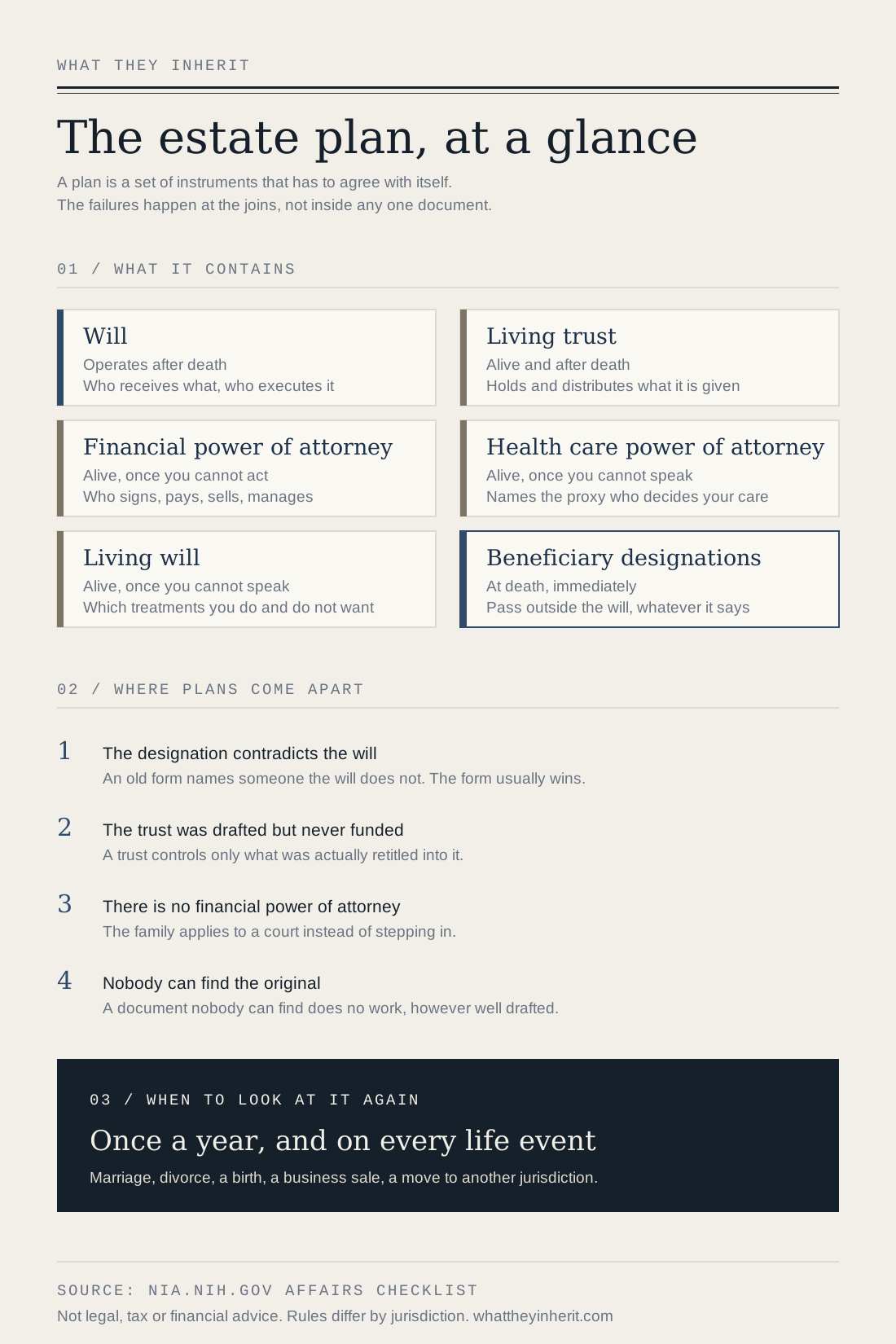
| Instrument | When it operates | What it decides |
|---|---|---|
| Will | After death | Who receives what, who executes it, who cares for minor children |
| Living trust | While alive and after death | Who holds and distributes named property, under stated instructions |
| Durable power of attorney for finances | While alive, once you cannot act | Who signs, pays, sells and manages on your behalf |
| Durable power of attorney for health care | While alive, once you cannot communicate | Names the proxy who makes medical decisions for you |
| Living will | While alive, once you cannot communicate | Which treatments you want and do not want |
| Beneficiary designations | At death, immediately | Who receives specific accounts and policies, outside the will |
Six rows, and only the first is what most people mean when they say they have sorted it out. The gap between row one and the other five is what this page is about.
The document that controls the money is often not the will
This is where a plan most often surprises the person who made it, and it is a reason a perfectly drafted will can still produce an outcome its author would not have wanted.
Retirement accounts, life insurance policies and many bank and brokerage accounts carry a beneficiary designation: a name recorded with the institution. The name on that form does not have to be a relative, which is why a gift to charity can be made on the form rather than in the will. Assets held jointly with a right of survivorship behave in a similar way. Those assets commonly pass straight to the named or surviving person at death, by contract or by operation of the account, and the will has nothing to say about it.
How far that reaches depends on the type of account, on the law where you and the assets are, and, for employer retirement plans in the United States, on federal rules that can displace what state law would otherwise do. This page is not going to summarise those rules, because there is no summary that is accurate for every reader. The part that holds everywhere is narrower and more useful: never assume the will reaches an account that already names somebody.
So a will that leaves everything equally to three children, sitting alongside a retirement account still naming a former spouse from a marriage that ended fifteen years earlier, does not produce three equal shares. It produces the will's instruction for part of the estate and the designation's instruction for the rest, and a family that cannot understand why.
Nobody notices, because the designation was made once, at account opening, on a form, in a different decade.
The audit is unglamorous and takes an afternoon. List every account, policy and pension. For each one, find out whether it carries a named beneficiary. Compare that name to what the will says. Where the two disagree, decide which is right and fix the one that is wrong. For the time it takes, this audit closes a gap most families never know is open, and it costs nothing but the afternoon.
The half of the plan that operates while you are alive
Incapacity is harder to plan around than death, because the estate is frozen while the family is still paying for everything.
Two instruments cover it. A durable power of attorney for finances names the person who can sign, pay, sell and manage on your behalf. Advance directives cover the medical side: the National Institute on Aging explains advance directives as documents that take effect only if you cannot communicate your own wishes, and describes both the living will and the durable power of attorney for health care.
Without a financial power of attorney, a family whose parent has had a stroke does not simply take over. They apply to a court. That process costs money, takes time, and hands a stranger a decision the family assumed was theirs. Courts, not relatives, end up deciding, which is the outcome nearly every other instrument in this article exists to prevent.
Naming the agent is only half of it. The Consumer Financial Protection Bureau publishes guides on managing someone else's money for exactly the people who end up in these roles, and the useful point in them is that acting as someone's fiduciary is a set of duties, not a favour. Anyone you name should be told, should agree, and should read something on what the role requires before they are doing it under pressure.
The trust that was never funded
Trusts fail in a specific and quiet way. The document gets drafted and signed, and then the property never gets moved into it.
A living trust only controls what it actually holds. If the house was never retitled, if the account was never transferred, the trust is an empty container with an excellent set of instructions. The family finds out when the estate is already in motion.
Funding is the step that gets skipped because it is administrative rather than legal, so it falls in the gap between the lawyer who drafted and the client who assumed drafting was the delivery. Ask the direct question: which assets are now titled in the name of the trust, and which are not.
Where the plan is kept, and who can find it
Federal guidance is blunt about this and it is worth taking literally. The affairs checklist says to put important papers and copies of legal documents in one place, and to tell someone you trust, or a lawyer, where to find them.
A document nobody can put their hands on does no work at all, however well it was drafted. A set of instruments is easier to mislay than a single one: a will held at a solicitor's office and a power of attorney sitting in a desk at home are both technically kept, in two places nobody connects. That is the worse failure, because the family finds one half and proceeds as though nothing is missing. Digital accounts have made it harder again, since the login that reaches the statements now sits behind a phone nobody can unlock.
The scale of misplaced money is visible in public infrastructure built to deal with it. The federal government maintains a directory for searching for unclaimed money held by state and federal agencies, which exists because assets separate from their owners routinely enough to require a permanent public search facility.
Write a location document. One page, not stored inside the safe it describes, naming where the will is, who holds a copy, which institutions hold accounts, who the professional advisers are, and how the person who has to do this reaches the digital side of your life.
Tax, and the honest limit of what this page can tell you
Estate and gift tax rules are jurisdictional, they change, and they are the part of this subject where confident writing does the most harm.
For readers in the United States, the Internal Revenue Service publishes the current position on the federal estate tax and answers on gift taxes for people considering giving during their lifetime. Read the primary source rather than any secondary summary of it, including this one, and note that state-level treatment is separate from the federal position and can differ sharply.
Survivor benefits sit in the same category. The Social Security Administration's survivors pages set out what a surviving spouse or child may be entitled to, which is frequently overlooked in planning conversations that focus only on private assets.
The rule this publication applies: never plan around a threshold you read on a website, including this website. Confirm it with a qualified professional in the jurisdiction where you actually live and where the assets actually sit.
Reviewing it, which is the part most people let slide
The affairs checklist recommends reviewing your plans at least once each year, and immediately after any major life event such as a divorce, a move, or a significant change in health.
Events matter more than the calendar. A plan assembled before a remarriage, before a company was sold, or before the family moved country stays entirely valid and can still deliver a result its author would have refused. Validity is not the same as fitness. An instrument goes on being enforceable long after it has stopped describing the family it was written for.
Book the annual review. Treat any of those events as an immediate prompt rather than something to reach eventually.
What a finished plan does not do
Everything above is administration. Done properly it removes the failures that turn an estate into an argument, and it is worth the afternoons it costs.
It also has a hard limit. A coordinated set of instruments moves assets accurately and moves nothing else. Your reasoning does not travel inside a designation form. Ask an heir why an asset was arranged the way it was and most will guess, confidently, because nothing on record ever told them otherwise. A legacy letter is the unofficial document that carries that part, and it is the one piece of this subject that costs an evening rather than a fee.
Two other pages sit either side of this one. Where the central instrument is still unwritten, what a will has to do and where it usually fails takes the document apart on its own terms. Where an estate is meant to stay whole rather than be divided, the difficulty stops being administrative altogether: that is why generational wealth comes apart, and the reasons rarely trace back to how the paperwork was written. And where the arrangement being considered is a trust rather than a document, what a family trust actually creates, and who has to run it treats the trusteeship itself as the subject.
Last reviewed by the What They Inherit Editorial Team on August 18, 2026. Our sourcing and AI-use rules are public on the editorial standards page. This is general editorial content and not legal, tax or financial advice. Estate, trust and tax rules differ by jurisdiction and change over time. Speak to a qualified professional where you live, and where your assets are held, before acting on anything here.
FAQ
What are the five documents in an estate plan?
Federal guidance from the National Institute on Aging names the common ones as a will, a durable power of attorney for finances, a living trust, a living will and a durable power of attorney for health care. Most people also need to treat their beneficiary designations as part of the plan, because those instructions operate independently of the will and frequently contradict it.
What is the difference between a will and a living will?
They share a word and almost nothing else. A will operates after death, and decides who receives what, who executes it and who cares for minor children. A living will operates while you are alive, once you can no longer communicate, and states which treatments you want and do not want. It is one of the advance directives the National Institute on Aging describes as documents that take effect only if you cannot communicate your own wishes. One instrument speaks for your estate and the other speaks for your body, so having either one in place does nothing at all to cover what the other does.
What is the biggest mistake in estate planning?
Writing the will and stopping there. The will is one instrument among several, and the failures cluster at the joins: a beneficiary designation naming someone the will does not, a trust that was drafted but never funded, no financial power of attorney at all, or an original document nobody in the family can find.
Do I need a trust or is a will enough?
That is specific to your jurisdiction and your assets, so it belongs with a qualified professional rather than an article. What this page can tell you is the part that does not change with the answer. A trust is one instrument out of six, it controls only what has actually been retitled into it, and it fails quietly when it is drafted and never funded. Whichever way the advice lands, ask which assets now sit in the trust's name and which do not.
What is a durable power of attorney?
A durable power of attorney is a document you sign, while you still have the capacity to sign it, naming the person who can act for you once you cannot act for yourself. There are two of them and most plans need both. A durable power of attorney for finances names who can sign, pay, sell and manage on your behalf. A durable power of attorney for health care names the proxy who makes medical decisions once you cannot communicate your own, which the National Institute on Aging groups with the living will as an advance directive. Two points about timing catch families out. The document has to be signed while capacity is still there, which is why it cannot be arranged after a stroke, and it ends at death, so holding one does not make you the executor. What the document is called varies by jurisdiction, so confirm it with a qualified professional licensed where you live.
What happens if I become incapacitated without a power of attorney?
Your family generally cannot simply step in and manage your affairs. In most places they have to apply to a court to be appointed, which means an application, a hearing, professional fees and a wait, all of it running while the bills keep arriving. A court appointment also tends to carry ongoing reporting duties that a private power of attorney would never have imposed. A financial power of attorney is one of the simpler documents to put in place, and it is the one that prevents this exact outcome.
How often should an estate plan be reviewed?
At least once a year, and immediately after any major life event, which is what the National Institute on Aging's affairs checklist recommends. The events matter more than the anniversary: a remarriage, a separation, a new child, the death of someone you named, the sale of a company, a serious change in health, or a move to another country.
What does it mean to fund a trust?
Funding is the step where the property is actually moved into the trust's name, and it is separate from drafting the document. A living trust only controls what it actually holds, so if the house was never retitled and the account was never transferred, what exists is an empty container with an excellent set of instructions. Funding gets skipped because it is administrative rather than legal, and it falls in the gap between the lawyer who drafted and the client who assumed drafting was the delivery. The family tends to find out when the estate is already in motion. Ask the direct question instead: which assets are now titled in the name of the trust, and which are not.
How do you get power of attorney for an elderly parent?
You do not get it, your parent grants it, and that is the part most families discover too late. A durable power of attorney for finances is a document your parent signs while they still have the capacity to sign it, naming the person who can sign, pay, sell and manage on their behalf. If it is already in place, there is nothing for you to obtain. If it is not, and capacity has already gone, the route is no longer a signature. A family whose parent has had a stroke does not simply take over, they apply to a court to be appointed, which means an application, a hearing, professional fees and a wait, all of it running while the bills keep arriving. The practical move is to raise it while it is still a conversation rather than a court date, and to tell the person being named, because acting as someone's fiduciary is a set of duties rather than a favour. What the document is called and what a court appointment involves vary by jurisdiction, so confirm both with a qualified professional licensed where your parent lives.
Does a will override a beneficiary designation?
Generally no, and it helps to understand why rather than just to memorise it. A designation is an arrangement between you and the institution holding the account, made on the day the account was opened, and it does not consult the will at all. That is not a loophole, it is how the instrument was built. It is also the whole argument for auditing a plan as a set rather than as a stack of separate documents. For the will's own limits, see what a will has to do and where it usually fails.
Does power of attorney end at death?
Yes, and it ends at the exact moment the family expects it to be most useful, which is why this one catches people out. Read the table at the top of this page again. A durable power of attorney for finances operates while you are alive, once you cannot act. A will operates after death. Those two rows do not overlap by a single day. The authority to sign, pay, sell and manage on someone's behalf stops when they die, and from that point the estate is run by the other instruments instead: the will through the executor it names, the trust through its trustee for whatever was actually funded into it, and the beneficiary designations, which pay out directly without consulting either. The consequence worth writing down is that holding power of attorney does not make you the executor. They are two separate appointments, made in two separate documents, and one stops precisely where the other starts. A family in which one person has been paying a parent's bills for two years, and assumes they simply carry on the following week, is a family that is about to discover otherwise at the bank counter. How an executor is confirmed and what the paperwork is called vary by jurisdiction, so confirm both with a qualified professional licensed where the person lived.
Is a living will the same as an advance directive?
No. One is a category and the other is a member of it. Federal aging guidance treats advance directive as the umbrella term for paperwork that comes into force only at the point you can no longer make your own wishes known, and it places two documents under that heading. The living will is the one that records which treatments you would accept or refuse. The other is the durable power of attorney for health care, which appoints a person to decide for you rather than setting the decisions down in advance. So a living will is not an alternative to an advance directive. Where a real choice exists, it is between recording instructions ahead of time and naming somebody to decide at the time.
What is a living trust?
A living trust is a legal arrangement that holds named property and distributes it under stated instructions, and unlike a will it operates both while you are alive and after death. The National Institute on Aging names it as one of the five documents in a common estate plan. The defining limit is the one most people miss: a living trust only controls what it actually holds. If the house was never retitled into the trust's name and the account was never transferred, what exists is an empty container with an excellent set of instructions, and the family discovers it when the estate is already in motion. That step is called funding, it is administrative rather than legal, and it is separate from drafting the document. Whether your family needs one at all depends on your jurisdiction and your assets, so it is a question for a qualified professional where you live rather than for an article.
What is a beneficiary designation?
A beneficiary designation is a name recorded with the institution that holds an asset, and it decides who receives that asset at death. Retirement accounts, life insurance policies and many bank and brokerage accounts carry one, and the name on the form does not have to be a relative. Two things make it matter more than its paperwork suggests. It pays at death immediately, outside the will and without waiting for the estate to be settled, which makes it the fastest moving instrument in the plan. And it operates independently of the will, so when the two disagree the form is not corrected by the document. That is why this page treats beneficiary designations as a required sixth item alongside the five the National Institute on Aging names, rather than as account admin. Assets held jointly with a right of survivorship behave in a similar way. The practical instruction is to read every form you have already signed, because the failures in an estate plan cluster at exactly this join.
Sources
- checklist for getting your affairs in order (nia.nih.gov)
- National Institute on Aging explains advance directives (nia.nih.gov)
- managing someone else's money (consumerfinance.gov)
- searching for unclaimed money (usa.gov)
- federal estate tax (irs.gov)
- gift taxes (irs.gov)
- Social Security Administration's survivors pages (ssa.gov)